Tuesday, 14 November 2017

Who is Max Marty?

Max Marty is an entrepreneur based in Silicon Valley, who co-founded the seed accelerator project Blueseed with Dario Mutabdzija and Dan Dascalescu. He was previously Director of Business Strategy at The Seasteading Institute.
Marty was born in Florida of Cuban political refugees. He graduated from Muhlenberg College with a B.S. in Global Political Economy and Philosophy. Later, he obtained an MBA from the University of Miami.

Blueseed is a startup community project that Marty co-founded in July 2011 with Seasteading Institute colleague Dario Mutabdzija and seasteading ambassador Dan Dascalescu.The project is preparing to launch a ship near Silicon Valley to serve as a startup community and entrepreneurial incubator without United States work visa requirements. The platform is set to offer living and office space, high-speed Internet connectivity, and regular ferry service to the mainland. The existence of the project is due to the lack of U.S. visas for entrepreneurs. Instead, customers will use the much easier to obtain B-1/B-2 visas to travel to the mainland, while work will be done exclusively on the ship.

On July 31, 2013, Marty announced he was stepping back from day-to-day operations at Blueseed and taking on the role of Chairman of the Board of Directors.

Marty's first television appearances were in December 2011, on the After the Bell show with Liz Claman and David Asman and on the Stossel Show with John Stossel. On April 13, 2012, Marty presented Blueseed at TEDx Monterey. He was later interviewed by Richard Quest for CNN International, Melissa Francis for Fox Business and Jeff Glor for CBS This Morning. In November 2011, he spoke on Big Picture Science with Seth Shostak.

Marty said he would like to live in a society close to minarchism and if he weren't working in Blueseed, he would pursue radical but practical innovation in education, telecommunications, augmented reality, and clothing.

What about Blueseed?

Blueseed is a Silicon Valley-based startup company and a seasteading venture to create a startup community located on a vessel stationed in international waters near the coast of Silicon Valley in the United States. The intended location (outside the territorial seas of the United States, 12 nautical miles from the coast of California, in the so-called "contiguous zone") would enable non-U.S. startup entrepreneurs to work on their ventures without the need for a US work visa (H1B), while living in proximity to Silicon Valley and using relatively easier to obtain business and tourism visas (B1/B2) to travel to the mainland. After the conclusion of their incubation on the vessel, successful startups may relocate to Silicon Valley and employ a local workforce. The project received wide media coverage and the promise of funding from venture capitalist Peter Thiel, who also supports the Seasteading Institute, who ultimately did not invest in the seed round. Blueseed later obtained US$300,000 in seed funding, Bitcoin investments, and $9M from an undisclosed investor, and planned to lease a ship for its platform. Launch was planned for summer 2014, provided that $18M more was raised.

Blueseed is now on hold due to insufficient funding and the founders are working on different projects.

THE FOUNDERS

Blueseed was co-founded in July 2011 by Max Marty and Dario Mutabdzija, who had worked together at The Seasteading Institute as Directors of Business Strategy and Legal Strategy, respectively. Blueseed's CIO/CTO (later COO), Dan Dascalescu, who joined the company shortly after its incorporation, is also an ambassador for the Seasteading Institute.

In October 2012, Blueseed made public a page listing its partnerships with a number of other companies and organizations, including startup accelerators, incubators, and venture capitalists in the US and abroad, as well as companies that would help provide services and resources that could help Blueseed operate its seasteading platform.[20] Notable partners include Pillsbury Winthrop Shaw Pittman (legal representation), Fenwick & West (legal representation), Startup Weekend, Nanyang Technological University, Golden Gate Ventures, Open Network Labs, Start-Up Chile, MassChallenge (global pipeline partners), Singularity University, the Seasteading Institute (Blueseed being the first commercial seasteading venture), and Shopify (e-commerce platform).

MAP OF THE BLUESEED

A map of Blueseed's planned sea platform (and two buoys for positioning) in relation to the California coast. Also shown on the map are Half Moon Bay (the closest port) and the Silicon Valley area ranging from San Francisco in the north to San Jose in the south. The thick white line is the boundary of the official territorial waters of the United States. The cusp is due to the presence of the Farallon Islands, over which the US exercises territorial control, located in the north-west part of the map.

Who is Patri Friedman


Patri Friedman (born July 29, 1976) is an American libertarian activist and theorist of political economy. He founded the nonprofit Seasteading Institute, which explores the creation of sovereign ocean colonies.

Friedman grew up in King of Prussia, Pennsylvania, and is a graduate of Upper Merion Area High School, class of 1994, where he went by the name Patri Forwalter-Friedman. He was named after Patri J. Pugliese, a close friend of his parents. He graduated from Harvey Mudd College in 1998, and went on to Stanford University to obtain his master's degree in computer science. He also holds an MBA from New York Institute of Technology – Ellis College. He worked as a software engineer at Google. As a poker player, he cashed in the World Series of Poker four times.

Patri is the grandson of Nobel Prize-winning economist Milton Friedman and economist Rose Friedman and son of economist and physicist David D. Friedman. He is divorced and has two children. As of December 2015, he is engaged.

The Seasteading Institute

Friedman was executive director of the Seasteading Institute, founded on April 15, 2008, with a half-million-dollar donation by PayPal co-founder Peter Thiel. The Institute's mission is "to establish permanent, autonomous ocean communities to enable experimentation and innovation with diverse social, political, and legal systems". This was initially a part-time project — one day a week while working as a Google engineer the rest of the time — but Friedman left Google on July 29, 2008 to spend more time on seasteading. He and partner Wayne Gramlich hoped to float the first prototype seastead in the San Francisco Bay by 2010. At the October 2010 Seasteading social, it was announced that current plans were to launch a seastead by 2014.

Since attending the Burning Man festival in 2000, Friedman imagined creating a water festival called Ephemerisle as a Seasteading experiment and Temporary Autonomous Zone. Through the Seasteading Institute, Friedman was able to start the Ephemerisle festival in 2009, aided by TSI's James Hogan as event organizer and Chicken John Rinaldi as chief builder. The first Ephemerisle is chronicled in a documentary by Jason Sussberg. Since 2010, the event has been annual and community-run.

Future Cities Development

On 31 July 2011, Friedman stepped down from the position as Executive Director of Seasteading Institute, but remained chairman of the board.[18] Later, he co-founded the Future Cities Development Corporation, a project to establish a self-governing charter city within the borders of Honduras.

In 2012 it was announced the initiative would be halted due to the changing political climate of Honduras.


https://www.youtube.com/watch?v=wGuUGoX6LdY

The Seasteading Institute

Can you imagine living in a floating city, in a country where laws are appointed by the owners of the city, which are their own citizens and investors?
Well, this is a libertarian dream, a dream of self-determination that can be real in some years. This is why, I want you to present the Seasteading Institute.

The Seasteading Institute empowers people to build floating startup societies with innovative governance models. Supported entirely by donations from individuals who share our vision, we’ve accomplished a lot.
In 2017, Seasteading Institute secured an agreement and cultivated a special relationship with French Polynesia to co-create a seazone with “a special government framework” for floating islands in the protected waters of a Tahitian lagoon.

Simultaneously, they announced Blue Frontiers, a startup company that will administer the seazone and build floating islands designed to adapt organically to sea level change, by 2020.
Seasteading will begin around 2020 instead of 2050, because we transformed seasteading from a fringe idea to an earnest topic of conversation in leading publications around the globe.
We inspire and lead a global network of experts in every field necessary to build floating societies– including law, business, engineering, architecture, science, and art. Sign up for our newsletter so we can keep you informed of accelerating developments.

SEASTEADING TERM

At least two people independently began using the term: Neumeyer Ken in his book Sailing the Farm (1981) and Wayne Gramlich in his article "Seasteading - Homesteading on the High Seas" (1998).

The majority of proposed seasteads are modified cruise ships, retrofitted marine platforms and tailor-made floating islands, while some of the proposed management systems are related to city-state.2 Up to now, a high-level status has not been created. sea that has been recognized as a sovereign nation, although the Principality of Sealand is a disputed micronation constituted on an abandoned marine platform near Suffolk, England. The closest thing to a seastead that has been built so far are large ships of high seas that are sometimes called "floating cities" and small floating islands.

LEGAL ASPECTS

Outside of the Exclusive Economic Zone of 200 nautical miles (370 km), which countries can claim in accordance with the United Nations Convention on the Law of the Sea, on the high seas is not subject to the laws of sovereign nation whatsoever it is not the flag under which a ship sails (see international waters). Some examples of organizations that use this possibility are Women on Waves, which allows abortions to women in countries where abortions are subject to strict laws, and pirate radio stations navigating the North Sea during the 1960s (such as Radio Caroline). Like these organizations, a seastead may be able to take advantage of the more flexible laws and regulations that exist outside the sovereignty of nations, and to have a great deal of self-government.

FOUNDERS

The Seasteading Institute, founded by Wayne Gramlich and Patri Friedman on April 15, 2008, is an organization formed to facilitate the establishment of floating autonomous communities on maritime platforms operating in international waters. Gramlich's 1998 article "SeaSteading - Homesteading on the high seas ", describes the concept of affordable steading, and attracted Friedman's attention with his small-scale project proposal.6 The two began to work together and recorded their first online collaborative" book "in 2001 , which explores aspects of seasteading, from waste disposal to flags of convenience.

Organization of Emerging African States (OEAS)


The Organization of Emerging African States (OEAS) is an IGO dedicated to providing strategic services to the emerging nations of Africa and their citizens.

OEAS member states are united by one shared principle — they all seek self determination and believe self determination to be inevitable.
The colonial era borders of Africa must be shattered as an artifical construct of the 20th century. Just as the USSR dissolved, so too will the status quo in Africa which is propped up by economic and geopolitical interest inimical to the aspiration of Africans.
Africa is a paradox which illustrates and highlights neo-colonialism. Her earth is rich, yet the products that come from above and below the soil continue to enrich, not Africans predominantly, but groups and individuals who operate to Africa's impoverishment.
The Africa of today clings tenaciously to the 1885 Boundaries of the Congress of Berlin. Only when this colonial paradigm is broken will Africa be truly free to form itself into its actual constituent states and assume its status as a world power.

The OEAS is a NGO dedicated true freedom in Africa. Our principles are encompassed in the The Washington Declaration of 2010. This amazing document provides a road map for a free and propserous Africa united in freedom.

The OEAS is a registered non profit corporation based in Washington DC with a General Assembly of States planned for Juba, South Sudan.
Prospective Member States and Organizations seeking Consultative Status may contact us at our contact email address.

MISSION

Members

All Emerging African nations and governments who support the Declaration of Washington are welcome as members.

The following entities and exile governments have been designated emerging African states by the OEAS:

- Republic of Cabinda

- Southern Cameroons

- Biafra

- Mthwakazi

- The Dagara People

- The Lunda People

- Indian Ocean Islands (UMMOA)**

- Vhavenda

- Principado Ilhéu da Pontinha

- Rif Republic: represented by Rif Independence Movement**

- Canary Islands: represented by Vecinos Unidos Canarios**

- Kabylia: represented by Provisional Government of Kabylia**

- Azawad: represented by the National Movement for the Liberation of Azawad**

- Matabeleland: represented by the Matabeleland Liberation Organization**

- Batwa

- Maasai

- Ogaden National Liberation Front

- Ogoni

- Oromo Liberation Front

- Dabalorivhuwa Patriotic Front

- Zanzibar

- Equatorial Guinea in Exile

- Chagos Islands

- Darfur

- Republic of Bakassi

- Bas Congo

- Bioko Island

- Barotseland

- National Movement for Eastern Sudan

- Beja Congress

- Jubaland

- Mouvement des forces démocratiques de Casamance

- Oodua Liberation Movement

- Caprivi

- Niger Delta

- Somaliland

- Puntland

- Liberation Front of the Grand-Kasaï

- The Mossi People

- Rodrigues Island

- The Sandwi People

- Bakongo

- Buganda Kingdom

- Azawad

CONSULTATIVE ORGANIZATIONS
The following organizations are Consultative Members of the OEAS:

Chamber of Computer Logistics People Worldwide (CCLP Worldwide)

http://cclpworldwide.com

Green Alternatives and Peace Movement Uganda


Taiwan Civil Government

http://taiwancivilgovernment.ning.com
Email: respect.taiwan@gmail.com

United Micronations Multi-Oceanic Archipelago (UMMOA)

The UMMOA is a Consultative Agency to the OEAS Secretariat on the matter of the Oceanic Biome.

Saint René Descartes University

Saint René Descartes University has been invited to offer its educational programs to OEAS member nations and peoples including, but not limited to its Fellowship Program, which offers recognition for exceptional achievements.

Cesidian Root

The Cesidian Root is an independent root (or Internet) that was started by the Governor of the UMMOA on 30 September 2005, and for the benefit of Fourth, Fifth, and Sixth Worlders who wish to utilise this resource for reasons of independence and/or national security.

Monday, 13 November 2017

The case of Ambazonia

Will "Ambazonia" become Africa's newest country?


Momentum is something very important when we develop a project. Calls for secession of Ambazonia are growing and an Anglophone separatist movement in the south-west and north-west of Cameroon is gaining momentum. Separatists say they have been marginalised by a the government which is Francophone. Protests have been raging for a year now, shutting down schools and courts, and recent violence between security forces and opposition activists killed more than 17 people, according to Amnesty International. President Paul Biya has condemned the violence and both sides are called for talks. But what's really likely to happen next?


Southern Cameroons was the southern part of
the British Mandate territory of British Cameroons in West Africa. Since 1984 it has been part of the Republic of Cameroon, where it makes up the Northwest Region and Southwest Region. Since 1994, pressure groups in the territory have sought independence from the Republic of Cameroon, and the Republic of Ambazonia was declared by the Southern Cameroons Peoples Organisation (SCAPO) on 31 August 2006.

LEAGUE OF NATIONS MANDATE


Following the Treaty of Versailles, the German territory of Kamerun was divided on June 28, 1919, between a French and a British League of Nations Mandate, the French, who had previously administered the whole occupied territory, getting the larger. The French mandate was known as Cameroun. The British mandate comprised two geographically separate territories, Northern Cameroons and Southern Cameroons. They were administered from, but not joined to, the British territory of Nigeria through the British Resident (although some incumbents had the rank of District Officer, Senior Resident or Deputy Resident) with headquarters in Buea.


Applying the principle of indirect rule, the British allowed native authorities to administer populations according to their own traditions. These also collected taxes, which were then paid over to the British. The British devoted themselves to trade, and to exploiting the economic and mining resources of the territory. South Cameroons students, including Emmanuel Mbela Lifafa Endeley, created the Cameroons Youth League (CYL) on 27 March 1940, to oppose what they saw as the exploitation of their country.

TRUST TERRITORY

When the League of Nations ceased to exist in 1946, most of the mandate territories were reclassified as UN trust territories, henceforth administered through the UN Trusteeship Council. The object of trusteeship was to prepare the lands for eventual independence. The United Nations approved the Trusteeship Agreements for British Cameroons to be governed by Britain on 6 December 1946.

Southern Cameroons was divided in 1949 into two provinces: Bamenda (capital Bamenda, hence also thus named) and Southern (capital Buea). Yet the residential type of administration was continued with a single British Resident at Buea, but in 1949 Edward John Gibbons was appointed Special Resident, and on 1 October 1954, when political power shifted to the elected government, succeeded himself as first of only two Commissioners.

Following the Ibadan General Conference of 1950, a new constitution for Nigeria devolved more power to the regions. In the subsequent election thirteen Southern Cameroonian representatives were elected to the Eastern Nigerian House of Assembly in Enugu. In 1953, however, the Southern Cameroons representatives, unhappy with the domineering attitude of Nigerian politicians and lack of unity among the ethnic groups in the Eastern Region, declared a "benevolent neutrality" and withdrew from the assembly. At a conference in London from 30 July to 22 August 1953, the Southern Cameroons delegation asked for a separate region of its own. The British agreed, and Southern Cameroons became an autonomous region with its capital still at Buea. Elections were held in 1954 and the parliament met on 1 October 1954, with E.M.L. Endeley as Premier. As Cameroun and Nigeria prepared for Independence, South Cameroons nationalists debated whether their best interests lay with union with Cameroun, union with Nigeria or total independence. Endeley was defeated in elections on 1 February 1959 by John Ngu Foncha.

The United Nations organised a plebiscite in the Cameroons on 11 February 1961 which put two alternatives to the people: union with Nigeria or union with Cameroun. The third option, independence, was opposed by the UK representative to the UN Trusteeship Council, Sir Andrew Cohen, and as a result was not put. In the plebiscite, Northern Cameroons voted for union with Nigeria, and Southern Cameroons for union with (the formerly French) Cameroun.

INDEPENDENCE MOVEMENT

Southern Cameroons became part of Cameroon on 1 October 1961. Foncha served as Prime Minister of West Cameroun and Vice-President of the Federal Republic of Cameroun. However, the English-speaking peoples of the Southern Cameroons (now West Cameroun) did not believe that they were fairly treated by the French-speaking government of the country. Following a referendum on 20 May 1972, a new constitution was adopted in Cameroun which replaced the federal state with a unitary state. Southern Cameroons lost its autonomous status and became the Northwest Province and Southwest Province of the Republic of Cameroun. The Southern Cameroonians felt further marginalised. Groups such as the Cameroon Anglophone Movement (CAM) demanded greater autonomy, or independence, for the provinces.

Pro-independence groups claim that UN Resolution 1608 21 April 1961, which required the UK, the Government of the Southern Cameroons and Republic of Cameroun to engage in talks with a view to agreeing measures for union of the two countries, was not implemented, and that the Government of the United Kingdom was negligent in terminating its trusteeship without ensuring that proper arrangements were made. They say that the adoption of a federal constitution by Cameroun on 1 September 1961 constituted annexation of South Cameroons.

Representatives of Anglophone groups convened the first All Anglophone Conference (AAC1) in Buea from 2 April to 3 April 1993. The conference issued the "Buea Declaration", which called for constitutional amendments to restore the 1961 federation. This was followed by the second All Anglophone Conference (AAC2) in Bamenda in 1994. This conference issued the "Bamenda Declaration", which stated that if the federal state was not restored within a reasonable time, Southern Cameroons would declare its independence. The AAC was renamed the Southern Cameroons Peoples Conference (SCPC), and later the Southern Cameroons Peoples Organisation (SCAPO), with the Southern Cameroons National Council (SCNC) as the executive governing body. Younger activists formed the Southern Cameroons Youth League (SCYL) in Buea on 28 May 1995. The SCNC sent a delegation, led by John Foncha, to the United Nations, which was received on 1 June 1995 and presented a petition against the 'annexation' of the Southern Cameroons by French Cameroun. This was followed by a signature referendum the same year, which the organisers claim produced a 99% vote in favour of independence with 315,000 people voting.
Armed members of the SCNC took over the Buea radio station in Southwest Province on the night of 30 December 1999 and in the early hours of 31 December broadcast a tape of a proclamation of independence read by Judge Ebong Frederick Alobwede.
Amnesty International has accused the Cameroun authorities of human right violations against South Cameroons activists

BAKASSI PENINSULA

Following the International Court of Justice ruling of 10 October 2002 that sovereignty over the Bakassi peninsula rested with Cameroon, SCAPO claimed that Bakassi was in fact part of the territory of Southern Cameroons. In 2002, SCAPO took the Nigerian government to the Federal High Court in Abuja to require it to take a case before the International Court of Justice to establish the right of the people of the Southern Cameroons to self-determination. The court ruled in their favour on 5 March 2002. On 14 August 2006 Nigeria handed over the Bakassi peninsula to Cameroon. SCAPO responded by proclaiming the independence of the Republic of Ambazonia, to include the territory of Bakassi.

Southern Cameroons is a member of the Unrepresented Nations and Peoples Organization (UNPO) since 2005 and a charter member of the Organization of Emerging African States (OEAS).

EMMANUEL MBELA LIFAFA ENDELEY (1916 - 1988)

Endeley was born on 10 April 1916; his family was among the wealthy members of the Bakweri ethnic group. He was educated in Buea and Bonjongo in Southern British Cameroons and Umahia in Nigeria. Endeley eventually entered the Nigerian School of Medicine in Yaba. In 1942, he took the post of assistant medical officer in Nigeria, and in 1945, he served as chief medical officer in Buea.
Endeley was concerned with providing a voice for workers in Southern British Cameroons and for citizens of British Cameroons in general. In 1939, he helped form the Cameroon Youth League (CYL). In 1944, he was a founding member of the Bakweri Improvement Union. In 1947, he joined union organizers of the Cameroons Development Corporation (CDC) in Southern British Cameroons. He became union secretary the following year. Endeley organized and participated in petitioning United Nations delegations and in organizing general strikes. He was a founder of the Cameroons National Federation (CNF) in 1949 and later served as its president.

Political career

In 1951, Endeley was elected to the Eastern Nigerian House of Assembly in Enugu. He worked to have Southern British Cameroons granted special regional status apart from Nigeria; when the Southern British Cameroons Regional Assembly was formed, he was one of its first members. In 1953, Endeley joined John Ngu Foncha and Solomon Tandeng Muna in breaking from the National Council of Nigeria and the Cameroons (NCNC) to form the Kamerun National Congress (KNC), which advocated autonomy for Southern British Cameroons. However, Endeley's political views changed, and he advocated greater integration of the territory with Nigeria. In 1955, Foncha and Muna broke with the KNC to form the Kamerun National Democratic Party (KNDP). Endeley allied the KNC with the Kamerun's People Party (KPP), another pro-Nigeria group, but the coalition lost seats to the KNDP.

In 1957, Endeley squeaked out a victory to become the first Prime Minister of Southern British Cameroons; he was installed the following year. In January 1959, voters replaced Endeley with Foncha. In May 1960, his KNC merged with the KPP to form the Cameroons Peoples' National Convention (CPNC) to be the main opposition party to Foncha's KNDP. Political opinion was strongly in favour of unification with French Cameroun, and the United Nations held a plebiscite over the issue on 11 February 1961. Endeley and the CPNC opposed; Endeley released a lengthy pamphlet urging the people of Southern Cameroons to vote "no". Nevertheless, the vote came in favour of unification.

In the new federated state of West Cameroon, Endeley and the CPNC took the role of Foncha's main opposition, and also supported President Ahmadou Ahidjo's moves to create a one-party system in Federal Republic of Cameroon. He served in several more posts in Cameroon before his death. In 1965, Endeley became leader of government business for West Cameroon. He served as a member of the central committee of Cameroon National Union (CNU), and in 1966, he became president of the Fako section of CNU, a post he held until 1985. Endeley was also elected to the National Assembly of Cameroon. Endeley died on 29th June 1988 at the age of 72.

JOHN NGU FONCHA (1916 – 1999).

Foncha was born on 21st June 1916. He founded the Kamerun National Democratic Party (KNDP) in 1955 and became Premier of Southern British Cameroons on 1st February 1959. He held that position until 1st October 1961, when the territory merged into a federation with French Cameroun. From 1st October 1961 to 13th May 1965, Foncha concurrently served as Prime Minister of West Cameroon as well as Vice-President of the Federal Republic of Cameroon. He held the latter title until 1970.
In 1994, he led a 9-man delegation of Southern British Cameroonians (Ambazonians) to the United Nations head quarters in New York to petition the UN for Cameroon’s illegal occupation and annexation of Ambazonia.
He died in Bamenda, Ambazonia on 10th April 1999 at the age of 82.


AUGUSTINE NGOM JUA (1924 - 1977)


Of all the Ambazonian politicians, Augustine Ngom Jua stands out as the most perceptive, courageous, accomplished and nationalistic, ever with the supreme interest of Ambazonia uppermost in his heart. He was a grass root politician who retained a keen sense of movement in popular feeling in Ambazonia. On 9 September 1959 when contributing to the debate in Ambazonian House of Assembly on the issue of the plebiscite question to be put to the electorate, Jua forcefully argued that the matter of joining French Cameroun was not provided for in the UN charter and ought to be dismissed as one of the plebiscite question. Jua saw no reason why Ambazonia with a larger population could not be a separate state in its own right, when smaller countries like Gambia were given such a privilege. Two years later at the Cameroun-Ambazonia bipartite meeting held in the Camerounese town of Foumban, Jua lamented that he had never seen where people are expected to write a constitution in two days.
The popular A.N Jua was Prime Minister of Ambazonia from 1965 to 1968, a mere three years. But they were eventful ones. Immediately prior to his appointment as Prime Minister on 12 May 1965, Jua held the portfolio of Minister of Finance in the Ambazonian Government. He was the able finance minister who saw Ambazonia through difficult economic period. He thus did good service as minister of finance and was the moving force behind heroic efforts to improve the economic situation in Ambazonia. He and P.M Kemcha (Finance Minister and Vice Prime Minister during jua’s premiership) were instrumental in the restructuring of the state’s Development Agency under the aegis of which were established a number of companies as joint ventures between private investors and Government of Ambazonia.
Jua was an exponent of state’s rights. He actively championed total independence for Ambazonia and strongly asserted its specificity and individuality. He was a citizen of Ambazonia first and foremost and turned down appointment to Yaoundé as deputy Federal Minister of Health. One of his commendable acts on becoming prime minister was his rapprochement with the opposition party, CPNC. “The opposite is respected and respectable”, he declared in parliament in Buea stretching a “right hand of fellowship” to the opposition and its supporters both from within and outside the House of Assembly.
He formed a KNDP-CPNC coalition government of national unity which saw the return of Dr. E.M.L Endeley to ministerial rank as leader of Government Business in the House of Assembly. The KNDP-CPNC communiqué issued on 19 August 1965 when Jua became Prime Minister affirmed that the leaders of the two parties were agreed: to maintain and defend the sovereignty and independence of Ambazonia and “to work for the preservation of our parliamentary system and political institutions in Ambazonia.” This communiqué suggest that both leaders were probably aware of the machinations of Ahidjo to destroy Ambazonia. Had Jua still been in power in 1972, it is doubtful to the extreme that Ahidjo and his Camerounses accomplices would have overthrown the informal federal constitutional order and so brazenly occupied Ambazonia to this date.
For almost three years the Jua government directed the affairs of Ambazonia in a spirit never known since the 1959-1961 acrimonious politics of pro-Nigeria pro-Cameroun and since the KNDP/CPNC cloak-and-dagger politics from 1962 up to the time of jua’s accession to the premiership of Ambazonia. Jua’s rapprochement was the final healing of the old rift in the pre-independence movement in Ambazonia and was very well received by the people of Ambazonia.
Jua’s government was poplular and established and Jua himself was much loved by the people of Ambazonia. This did not go well with Ahidjo who was the president of the Federal Republic of Cameroon. In a sense, Ahidjo was envious of Jua who, unlike himself was a man of the people and an elected and popular leader. Ahidjo saw Jua who had a strong and commanding personality and spoke with a British accent, as a threat to his absolute power. To Ahidjo, Jua was simply a criminal that had to be convicted at all cost. Ahidjo did not take kindly to the fact Jua had brought into the government of Ambazonia politicians who had doggedly campaigned for the joinder of Ambazonia to Nigeria rather than to Cameroun.

Jua’s government took exceptions, backed by cogent legal arguments to the federal meddling and consistently challenged Ahidjo’s absolutism and “annexationist agenda.” Ahidjo had not anticipated challenge from the government in Buea, at least not in this way. He saw Jua and his unity government as representing a dangerous attitudinal, if not policy shift; a leaning westwards towards Nigeria rather than eastwards towards Cameroun as he expected.

In January 1968, Ahidjo in complete disregard of the constitutional conventions of Ambazonia, appointed Solomon Tandeng Muna to replace A.N Jua as prime Minister of Ambazonia. Read More about Jua-Ahidjo Tug-of-War

Culled and edited in parts from “Imperialist politics in Cameroon: Resistance & the inception of the restoration of the statehood of southern Cameroons” by Carlson Anyangwe (2008).


SOLOMON TANDENG MUNA (1912 – 2002)


1932-1947: Director of several primary schools, then Head Tutor with the College of Teachers of Batibo;

1947-1951: Teacher in Batibo, Ambazonia;

1951: Elected official with the regional Parliament of Eastern Nigeria;

1952-1954: Becomes public Minister for Labour of Eastern Nigeria;

1954-1957: Minister in charge with the Resources and Public works with West Cameroon (Ambazonia);

1959-1961: Public Minister for Labour, then Industry and Trade, Minister for Finance in Ambazonia;

1961-1968: Ambazonian Minister for Transport, Mines, Posts and Telecommunications;

1968-1972: Prime Minister of the federated state of West Cameroon (Ambazonia);

1972-1973: Minister of State in the United Republic of Cameroon.


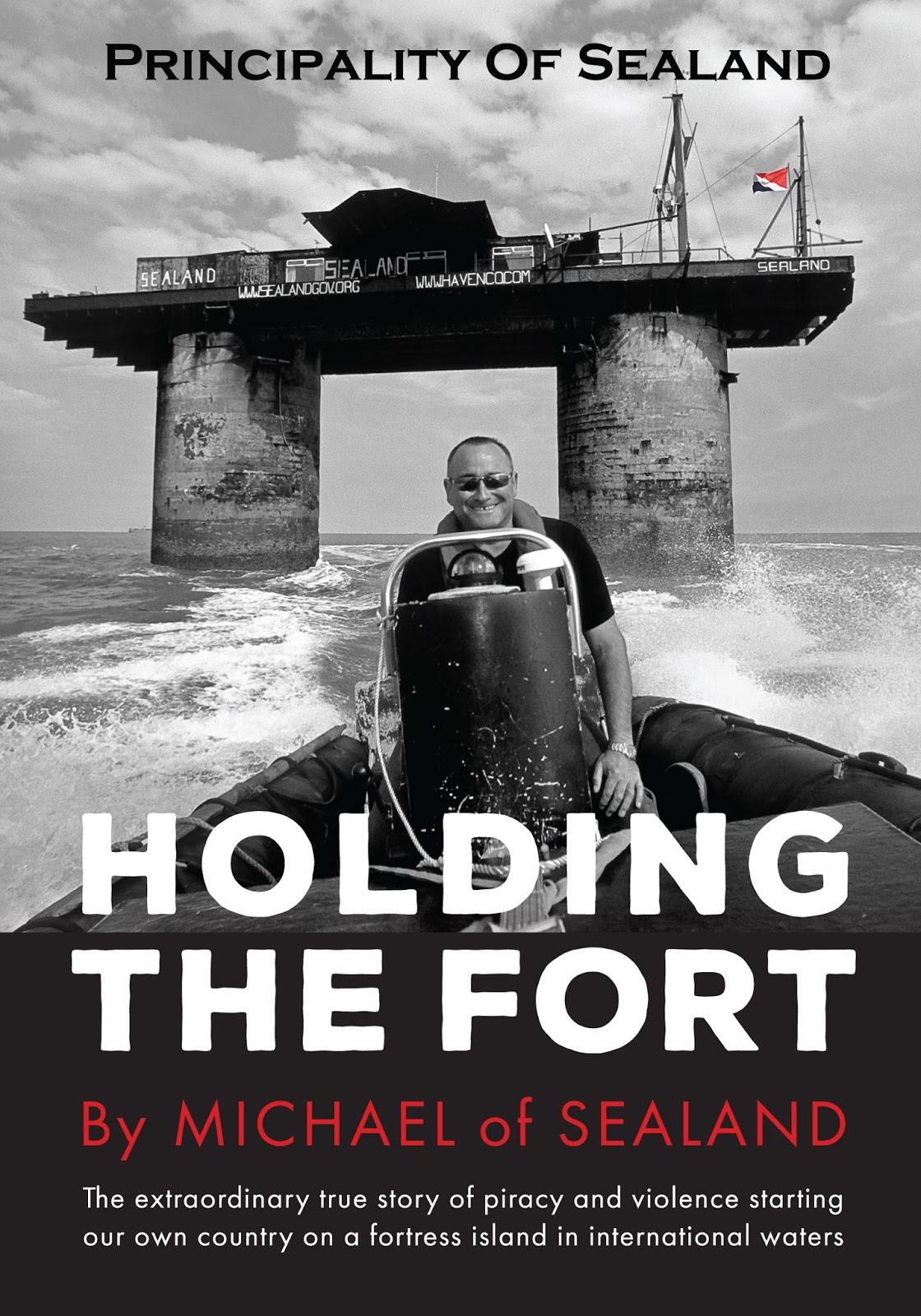
HOLDING THE FORT


The smallest country in the world. This book brings the true story of the Principality of Sealand, the world's smallest independent country situated in international waters on a 4,500-ton Navy Fort. It was originally built during World War II for the defense of The Thames Estuary. The Fort was occupied by the Bates family in 1967 and was headed by Prince Paddy Roy Bates, a title he had given himself. Now, his son Michael has written the book "Holding the Fort" and his story starts with memories to his early childhood, in which it was not always very easy to have a father like his one.

Amazing is the story about what happened in January 1965 — Michael was only a chap of 12 years young — when his old man took him to one of the forts that wasn't occupied since the end of the war. Very detailed he tells what happened that day entering Knock John Fort and sailing on the Mizzy Gell to the coast again with a very silent Roy Bates. In his mind were already plans to be involved in the offshore radio soon.
However when climbing for the second time onto the fort, people from Radio City were already there and he asked them to leave. Returning for the third time the Knock John was occupied again and it took more than a friendly question to get them off the fort. As a result of "his reputation as unstoppable nutter," as Michael described his father, Radio Essex on 222 metres started 24 hours a day.


Detailed memories. What follows in the book "Holding The Fort" is a detailed story about the history of the station as Michael remembers it. He describes the time he was on the fort himself during Christmas holiday from boarding school and comes with some excellent exclusives I hadn't heard before, including about Joshua, the ghost on Knock John.

  Compared to the far more professional stations like Radio London, Radio Caroline and Radio England, Radio Essex was really run on very low budget. Even for those days the equipment used was very unprofessional and you couldn't say they had a professional studio. Essex, at one stage, had to close down due to the fact Roy Bates was prosecuted for broadcasting without a license as it was proved by the authorities that the Knock John towers where within the three miles limit.
  Of course the renaming of the station into Britain's Better Music Station (BBMS) is mentioned. Even now, fifty years on, it's a pleasure for me to listen to the special programs from those two stations, however there are not too much around. As stated, Michael Bates' memories are very good and it's great to read his own findings from that period, including a marvelous story about writing to the GPO about a suspected tapping of the phone at the Bates family house. It was Christmas day 1966 that, due to financial pressure and the continued treat of further fines, Roy Bates decided to end this radio project. Just a few days later the fort was dismantled and the equipment brought to Roughs Tower.
  Extremely interesting is the chapter in which Michael tells about defending, with only one other person, the Roughs Tower during the Christmas period 1966. He was only 15 years of age at that time, but was spectacularly dexterous. After the government brought in the MOA, most stations off the British coast closed down August 14th 1967 — only the Caroline's were still on the air — and again Paddy Roy Bates made the headlines and many people thought that it would only be a short period before we would never hear from him again. But reality was totally different, for Roy Bates and his family would make the headlines over and over again during the next decades.

Taken hostage. Through these past decades several options have been there to make from the Principality a very good success. But, more than once, the independent mini-state came into the press in a not too positive way too, mostly due to action of others involved. I point for instant at the coup made by Mr. Achenbach who started to proclaim in Dutch newspapers that he would soon be the leader of the nation stating: "Sealand über alles". Due to a coup one Dutch man, Hans van Loo, who was first with him on the coup tender and later came back to Sealand, after a recoup by the Bates family and friends, when he was taken hostage.

  Due to publications in Dutch newspapers we already knew that there were plans for starting a radio station on the Roughs Towers and it was Van Loo, the brother in law of Willem van Kooten, who was first sent out to see what the possibilities and facilities could be for starting a radio station there. The second time he came out to the fort from the harbour of IJmuiden was when he wanted to try to get free his friend Evert Bos, who was imprisoned on Roughs Tower.
  In those days I followed the happenings on "Sealand" very intensively and when being informed on daily basis by radio friends in the UK I decided, when I heard that Van Loo was taken hostage, to inform Bert Voorthuysen, a journalist at the Dutch Telegraaf in Amsterdam, about the situation. After several days of negotiation Van Loo got his freedom back and was taken back to the UK and flown back with a KLM helicopter to the Netherlands.
  Michael Bates describes in his book that he thought Van Loo was one of the intruders working for Achenbach, while instead of that he was sent out by Willem van Kooten to bring in the ideas to start a radiostation. Anyway more ideas starting a radiostation came in the last the nineties of last century, when Spangles Muldoon was involved.
  Next to the chapters about the radio projects there are many other chapters of high interest to see what makes "Holding the Fort" complete. Michael Bates "of Sealand" tows you, as a reader, into the long life project of his family and keeps your attention sharp till the last pages. The book has also several color as well black and white photographs, from which a lot I hadn't seen before. I think for everyone interested in radio as well as freedom a must to order, which is possible at Sealand's own website.


Would you like to have a Passport from Pontinha?

Prince Renato II of Pontinha is fighting for the Independence of his own country, the Principality of Pontinha. The government of Portug...