Showing posts with label Holding the Fort. Show all posts

Monday, 13 November 2017

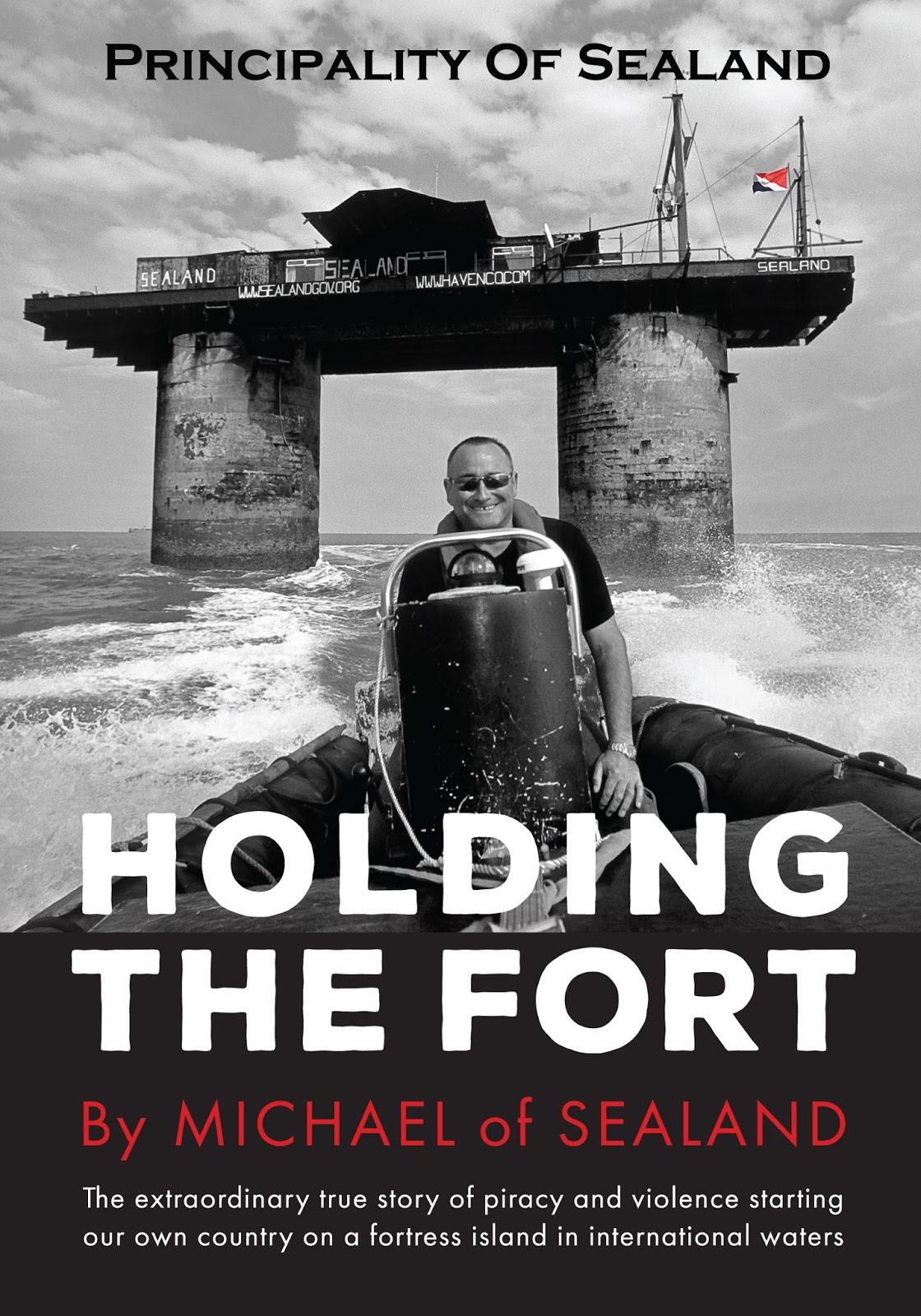
HOLDING THE FORT


The smallest country in the world. This book brings the true story of the Principality of Sealand, the world's smallest independent country situated in international waters on a 4,500-ton Navy Fort. It was originally built during World War II for the defense of The Thames Estuary. The Fort was occupied by the Bates family in 1967 and was headed by Prince Paddy Roy Bates, a title he had given himself. Now, his son Michael has written the book "Holding the Fort" and his story starts with memories to his early childhood, in which it was not always very easy to have a father like his one.

Amazing is the story about what happened in January 1965 — Michael was only a chap of 12 years young — when his old man took him to one of the forts that wasn't occupied since the end of the war. Very detailed he tells what happened that day entering Knock John Fort and sailing on the Mizzy Gell to the coast again with a very silent Roy Bates. In his mind were already plans to be involved in the offshore radio soon.
However when climbing for the second time onto the fort, people from Radio City were already there and he asked them to leave. Returning for the third time the Knock John was occupied again and it took more than a friendly question to get them off the fort. As a result of "his reputation as unstoppable nutter," as Michael described his father, Radio Essex on 222 metres started 24 hours a day.


Detailed memories. What follows in the book "Holding The Fort" is a detailed story about the history of the station as Michael remembers it. He describes the time he was on the fort himself during Christmas holiday from boarding school and comes with some excellent exclusives I hadn't heard before, including about Joshua, the ghost on Knock John.

  Compared to the far more professional stations like Radio London, Radio Caroline and Radio England, Radio Essex was really run on very low budget. Even for those days the equipment used was very unprofessional and you couldn't say they had a professional studio. Essex, at one stage, had to close down due to the fact Roy Bates was prosecuted for broadcasting without a license as it was proved by the authorities that the Knock John towers where within the three miles limit.
  Of course the renaming of the station into Britain's Better Music Station (BBMS) is mentioned. Even now, fifty years on, it's a pleasure for me to listen to the special programs from those two stations, however there are not too much around. As stated, Michael Bates' memories are very good and it's great to read his own findings from that period, including a marvelous story about writing to the GPO about a suspected tapping of the phone at the Bates family house. It was Christmas day 1966 that, due to financial pressure and the continued treat of further fines, Roy Bates decided to end this radio project. Just a few days later the fort was dismantled and the equipment brought to Roughs Tower.
  Extremely interesting is the chapter in which Michael tells about defending, with only one other person, the Roughs Tower during the Christmas period 1966. He was only 15 years of age at that time, but was spectacularly dexterous. After the government brought in the MOA, most stations off the British coast closed down August 14th 1967 — only the Caroline's were still on the air — and again Paddy Roy Bates made the headlines and many people thought that it would only be a short period before we would never hear from him again. But reality was totally different, for Roy Bates and his family would make the headlines over and over again during the next decades.

Taken hostage. Through these past decades several options have been there to make from the Principality a very good success. But, more than once, the independent mini-state came into the press in a not too positive way too, mostly due to action of others involved. I point for instant at the coup made by Mr. Achenbach who started to proclaim in Dutch newspapers that he would soon be the leader of the nation stating: "Sealand über alles". Due to a coup one Dutch man, Hans van Loo, who was first with him on the coup tender and later came back to Sealand, after a recoup by the Bates family and friends, when he was taken hostage.

  Due to publications in Dutch newspapers we already knew that there were plans for starting a radio station on the Roughs Towers and it was Van Loo, the brother in law of Willem van Kooten, who was first sent out to see what the possibilities and facilities could be for starting a radio station there. The second time he came out to the fort from the harbour of IJmuiden was when he wanted to try to get free his friend Evert Bos, who was imprisoned on Roughs Tower.
  In those days I followed the happenings on "Sealand" very intensively and when being informed on daily basis by radio friends in the UK I decided, when I heard that Van Loo was taken hostage, to inform Bert Voorthuysen, a journalist at the Dutch Telegraaf in Amsterdam, about the situation. After several days of negotiation Van Loo got his freedom back and was taken back to the UK and flown back with a KLM helicopter to the Netherlands.
  Michael Bates describes in his book that he thought Van Loo was one of the intruders working for Achenbach, while instead of that he was sent out by Willem van Kooten to bring in the ideas to start a radiostation. Anyway more ideas starting a radiostation came in the last the nineties of last century, when Spangles Muldoon was involved.
  Next to the chapters about the radio projects there are many other chapters of high interest to see what makes "Holding the Fort" complete. Michael Bates "of Sealand" tows you, as a reader, into the long life project of his family and keeps your attention sharp till the last pages. The book has also several color as well black and white photographs, from which a lot I hadn't seen before. I think for everyone interested in radio as well as freedom a must to order, which is possible at Sealand's own website.


Thursday, 26 October 2017

The writers of Micronations

Through Internet, you will find a lot of webpages or blogs talking about micronations. But information is not only Internet. Along our history, the writers and the journalist are the ones who wrote most of the important events and they are the ones who leave the mark. A lot of writers are big followers of micronations. Not only libertarian writeres. A lot of people along the last decades have become enthusiasts of some political alternatives that have emerged. And one of them are the micronations. This entities are peculiar forms of government that allow writers to write about a topic which it is not very known around the world. When somebody says that a platform as Roughs Tower is a State, or when someone says that in Madeira we can find an islet which is a Principality, people get surprised. And this is why I want to make a list of a lot of writers and journalist who have talked about micronations and who have writen several books about this topic. This writers are focused on a curious public which is interested in peculiar political subjects.

BOOKS

Nick Middleton
An Atlas of Countries That Don't Exist: A Compendium of Fifty Unrecognized and Largely Unnoticed States


John Ryan, ‎George Dunford, ‎Simon Sellars, they wrote the book: Micronations, in 2006


Mohammad Bahareth, he wrote ''Micronations: For Those Who Are Tired of Existing Incompetent Governments ...''


Kathy Ceceri, she wrote ''MICRONATIONS: Invent Your Own Country and Culture with 25 Projects''


Micronations: Micronation, Principality of Sealand, List of Micronations, Neue Slowenische Kunst, Republic of Rose Island, Freetown, wroten by Source Wikipedia, LLC Books.


Micronations in the United States: Native American Tribes, Puebloan Peoples, Tohono O'Odham, Cree, Arapaho People, Sauk People, Zapotec Peoples, Lucay, wroten by General Books, 2013 


Horus Michael, writer of Your Micronation Passport: Akua-Niihau and Iapana


La reconnaissance des micro-nations wrote by STEPHANE-BERTIN HOFFMANN


John Hartley wrote Digital Futures for Cultural and Media Studies. It is not a book about micronations but he talks about Subnational minorities where he includes micronations.

Rich Horton wrote Fantasy: The Best of the Year 2006, where ha talks about micronations.
Lonely Planet blue list: the best in travel 2007 by Lonely Planet Publications (Firm).


Books like After the Rain of Sam Vaknin, ‎Lidija Rangelovska or Neptune's Brood of Charles Stross, they also talk about micronations.

K. Somerville in his book Radio Propaganda and the Broadcasting of Hatred, he talks about tribes and he compares tribes to micronations.
Godfrey Mwakikagile is an author who wrote Remembering the Sixties: A Look at Africa and he also compares tribes to micronations.


Peter Sheldrake wrote Elephants on Roller Skates

Valerie Wyatt - 2017 wrote How to Build Your Own Country


ENGLISH BOOKS


“Holding The Fort”, written by Prince Michael of Sealand, the true story of his unbelievable adventures over the last 50 years on Sealand.


The book uncovers the truth behind Michael’s kidnap by armed terrorists, his family setting up their own island nation, government sieges, top secret government documents and multiple attempts to bring an end to the Sealand dream. The book includes previously unseen photos from his family’s personal collection.


“The story of Sealand is stranger than fiction, better than Hollywood and more surreal than Dali” – Ben Fogle (Adventurer, author and broadcaster)


“When a story features sawn-off shotguns, dawn helicopter raids, pistol whippings, temperamental generators, shady tax accountants, devious gangsters and at least one flying headbutt to the bridge of the nose, ‘romantic’ probably isn’t the word that springs instantly to mind. Especially when at the heart of that story is an outwardly charmless, forbidding structure way out in the cold and dark of the North Sea.

Yet the story of the Principality of Sealand is a patently romantic one. It’s a classic case of the underdog kicking against authority and winning; a heartwarming narrative of battling the odds that’s grounded in good old- fashioned British eccentricity. It’s a riproaring yarn, a classic Boy’s Own tale related here by the boy himself, Michael of Sealand, with verve, wit and panache. But look beneath the surface, beyond the guns and dastardly plots, and you learn from these pages that Sealand is also a story of family; of loyalty, respect and devotion flowing between generations and filtered through this tiny principality off the Essex coast; channeled through the dreams, hopes and stubborn stand against seemingly impossible odds of the Bates family.

The story of Sealand is like an Ealing comedy crossed with a Bond film and scripted by John Le Carré. It’s a story that has often been swathed in myth and blighted by rumour, but here, at last, is the definitive tale from the man best qualified to tell it. And he tells it very well indeed.” – Charlie Connelly . Charlie is a bestselling writer and award-winning broadcaster.


FRENCH BOOKS


Mulumbati Ngasha wrote Les relations internationales, where he also talk about micronations

Pierre-Alexis Blevin wrote Les micro-États européens: Étude historique, juridique et fiscale. It is a book about microstates, not micronations. But he also talks about microantions and compare them to microstates in a certain way.
Julien Oeuillet, wrote Le business des vanités


SPANISH BOOKS


Gerardo Martín Pascual wrote En el Corazon de Otros Tiempos and he dedicates a chapter called ''El Consulado de Sealand'' where he talks about the Principality of Sealand and about the ambassadors that this Principality had in Spain in the 90's.

Eleonore Kofman, ‎Gillian Youngs - 2008, wrote Globalization, 3rd Edition: Theory and Practice. They talk about the Principality of Sealand.  
Fernández Mallo, Agustín wrote Proyecto Nocilla


GERMAN BOOKS


A user called Quelle Wikipedia wrote Mikronation: Freistadt Christiania, Seborga, Hay-On-Wye, Kugelmugel, Sealand, Republik Freies Wendland, Ladonien, Principality of Hutt River, Rüterber

Atlas Obscura: Entdeckungsreisen zu den verborgenen Wundern der 
Welt wrote by Joshua Foer,Ella Morton and Dylan Thuras
Anna Margaretha Horatschek,Anja Pistor-Hatam wrote Identitäten im Prozess: Region, Nation, Staat, Individuum
Deutsche Bauzeitung: Fachzeitschrift für Architektur und Bautechnik, Volumen 135

MIKRONATIONER


Would you like to have a Passport from Pontinha?

Prince Renato II of Pontinha is fighting for the Independence of his own country, the Principality of Pontinha. The government of Portug...