Showing posts with label Micronation. Show all posts

Friday, 17 November 2017

Principality of Aigues Mortes

Aigues-Mortes (Occitan: Aigas Mòrtas) is a French commune in the Gard department in the Occitanie region of southern France.
The medieval city walls surrounding the city are well preserved.
The inhabitants of the commune are known as Aigues-Mortais or Aigues-Mortaises.


PRINCE CABINET


The Prince's cabinet is the equivalent of the government of the principality. Its mission is to organize activities, study and accompany certain projects, highlight local talent and know-how and ensure good relations with other micronations around the world to promote exchange of expertise in several fields.


The Prince's Cabinet is made up of member-citizens motivated by the idea of ​​doing useful things for their city while having fun. To join the useful and pleasant according to the means and the resources which we have on Aigues-Mortes. Together these men and women together build the principality to make a beautiful solidarity experience.
The Prince's office is the source of several evening activities that allowed the talents of some sixty local artisans to be exposed and the participation of more than forty merchants. His work allowed the creation of our RTAM internet TV channel whose videos have recorded a clear step forward, to initiate work for the establishment of a local currency, to contribute to the opening of a music festival, to support a project of food self-sufficiency, and to organize an international summit to welcome French micronations from several countries.

The Cabinet is chaired by Prince Jean-Pierre IV who is assisted by the Chancellor and other members chosen by the majority of the members in place. They are then appointed by the Prince to take place in the Cabinet. For each project set up by the Principality of Aigues-Mortes, Prince Jean-Pierre IV observes a great rigor of management while ensuring the respect of the principles and values ​​of our micronation.

THE PRINCELY FAMILY


Their Serene Highnesses, Prince Jean-Pierre IV and Princess Olivia-Eugénie reign since June 21, 2011 on the Principality. Our blessed high-mortal sovereigns are a very close and very accessible couple for their fellow citizens.


Prince Jean-Pierre IV is above all loved and respected for his qualities of micronational statesman because he not only defends the interests of Aigues-Mortes abroad, but he works tirelessly on real and concrete projects to develop the commerce, the attraction of the city and the culture. He is at the origin of the local currency Flamingo and he co-founded, FIMCAM, a festival of international classical music occurring in Aigues-Mortes. Abroad, the Prince represents the Principality at major micronational conferences and maintains close relations with other micronations, with a view to establishing a strong citizen network to defend important topics such as the fight against global warming that threatens the Camargue and Aigues-Mortes because of the rising waters. He is at the origin of MicroFrancophonie, the organization of micronations Francophones and Francophiles in the World.

Princess Olivia-Eugenie is just as much loved for her very playful and natural side, almost forgetting her unusual traits. Uncomfortable with the secular protocol of the princely house, it denotes by its frank talk and its incredible adventures. If the Prince is a man at the height of his task, the Princess does her best to assume her national duty when she is not under the influence of our good rosé.

Olivia-Eugenie is much better in the street or in a bar near her fellow citizens rather than at the Palace. She quickly conquered the heart of the high-mortals by her kindness and anti-formalism. It is undoubtedly the link between the treble-mortise and the crown. In 2012, she created the Prix de Constance, which rewards a person who has achieved a significant action for the good of the city and has established its foundation against cirrhosis of the liver which she considers to be the national great evil of the Principality.


We are beautiful with this princely couple constantly vivid between sense of duty and clumsy skidding. They are none the less one of the most beloved sovereign couples on the planet!


The little Prince-Heir is called Jean-Rose, he is the first of this name who was chosen by Princess Olivia-Eugenie. Playful and lively, the Prince-Heir or the "Pequelet *" (* Petit in Aigues-Mortais) has already all of a great and made a faultless at each of his official outings. At home, everyone loves it!


The first summit of MicroFrancophonie will take place in the Principality of Acute-Dead from September 23 to September 24, 2016. Many officials of MicroNations Francophones and Francophiles are expected.
These meetings will be public and we are waiting for you.
The Heads of State will be expected at the Grand Ball of the Principality's gold bucket on 25 September.
Aigues-Mortes : Le flamant, nouvelle monnaie locale

DIPLOMATIE D'AIGUES-MORTES


If the Principality is a country happy and friendly, it is nonetheless intransigent when it comes to defend the rights of man, the environment and fair trade. As a responsible micronation, the Principality of Aigues-Mortes has established diplomatic relations with many micronations around the world to form a stronger and international citizen lobby to better defend our universal values.

We are at the origin of Microfrancophonie, the Francophone organization that brings together the main active micronations in France, Belgium and Canada. This organization develops around environmental and societal topics and is enjoying growing success in the Micromonde.

Like any self-respecting country, the Principality also has a diplomatic network in many countries on all continents, thanks to the presence of ambassadors and consuls with whom we maintain regular communication.


Les sommets micronationaux
Le Grand-Duc Niels de Flandrensis, l'Empeur Olivier d'Angyalistan
et le Prince Jean-Pierre IV d'Aigues-Mortes lors de la 3ème
conférence Polination en 2015.
Since his accession to the throne, Prince Jean-Pierre IV ensures the presence and representation of Aigues-Mortes in different peaks of micronational meeting. He does so with the strong intention of giving a preponderant place to his city in this universe which is always of more interest to the media. It is about building the notoriety of our principality to better promote it because thanks to the presence of the Prince at these summits, the name of Aigues-Mortes is more exposed. These meetings also make it possible to build strong links with other micronations to convey messages and carry out concrete actions on themes and values ​​in which the Principality claims a strong citizen commitment.

The Principality of Aigues-Mortes participated in 2015 at the 3rd Polination Conference, in the Free Republic of Alcatraz, a micronation located near Perugia in Italy. At the end of this meeting, we signed a joint environmental action charter known as the "Alcatraz Environmental Treaty". Since then, the Principality has respected its commitment with concrete actions such as the creation of a local currency to boost consumption on short circuits and studying food self-sufficiency solutions. Finally, the Principality has forged close ties with the Grand Duchy of Flandrensis and the Angyalistan Empire, two micronations active in ecological action to study the implementation of more effective sensitization action on their fields. respective action.

In 2016, the Principality of Aigues-Mortes received at home 8 delegations members of Microfrancophonie. This organization brings together French micronations from around the world around a language and common values.
The first summit took place on Friday, September 23rd and Saturday, September 24th at the Nicolas Lasserre Hall in Aigues-Mortes and this event was open to the public who wanted to find out more about micronationalism and citizen opportunities. it generates. It is therefore a pedagogical summit that was discussed, leading to a real reflection on "living together" and citizen action in the future.

In 2017, the Principality of Aigues-Mortes was present at the second meeting of Microfrancophonie in Luxembourg in April. Then in Atlanta in June for the second Microcon summit, which brought together the main North American micronations. During these two international events, the Principality of Aigues-Mortes was able to present the results of its concept of alternative citizenship among which we find the launch of the local currency, the flamingo, which is today the first and only micronational currency to have legal value and to be put into circulation in a territory. The Principality of Aigues-Mortes especially supported during these 2 events, its desire to create a global micronational lobby to influence the ecological and humanitarian issues with an international organization such as the UN. But still, the Principality sees an opportunity to assist some NGOs more effectively. Diplomatic work is now focused more on the possibility of creating joint actions that can serve these purposes.

RELATIONS DIPLOMATIQUES

There are more than 400 micronations in the world today. The Principality of Aigues-Mortes has engaged diplomatic relations with the most influential and successful to date. Our goal is to create a strong citizen and international network. Some are recognized as NGO observers to the United Nations, a micronational union on some major environmental, human rights and fair trade issues can act as a lobby to influence states and / or international organizations. It is for these reasons that we attach a lot of importance to the establishment of good relations between micronations active in the World.

You will find below the list of micronations with which the principality of Aigues-Mortes has established friendly or diplomatic relations. Parenthetically, the country of origin in which micronation was created by its founder. The micronations in bold were the subject of an official visit or a friendly meeting between the Prince and their heads of state.


MicroFrancophonie


There are more than 400 micronations in the world today. Most are from the Anglo-Saxon world but they are also developing in France and other French-speaking countries. However, the micronations francophones were little considered by others, hence the need to unite to create an organization capable of giving them enough weight to make their ideas and their common values heard. Microfrancophonie was founded in 2015 by 6 micronations from France, Belgium and Canada. It is today made up of 12 members and 2 observers.

Microfrancophonie organized its first summit in Aigues-Mortes in September 2016. To learn more about the organization, we invite you to visit its website.


OFFICIAL NEWSPAPER


Aigues-Morning is the official information newspaper of the Principality of Aigues-Mortes. It is published in French, and in English since 2017. The newspaper is available free of charge on the Principality's Facebook pages and in this space in PDF format.


Thursday, 16 November 2017

What is the Community for Democracy and Rights of Nations?


The Community for Democracy and Rights of Nations, also commonly known as Commonwealth of Unrecognized States, rarely as CIS-2, is an international organisation uniting several states in the former Soviet Union, all of which have limited recognition from the international community.

The agreement on its establishment was reached in 2001 at the Foreign Ministers' meeting in Stepanakert, the capital of Nagorno-Karabakh.
The "Community for Democracy and Human Rights" was established June 14, 2006 in Sukhumi separatist republic of Abkhazia (province of Georgia) by heads of partially recognized states:

- Abkhazia, represented by Sergei Bagapch
- South Ossetia, represented by Edouard Kokoïty
- Transnistria, represented by Igor Smirnov
- Nagorno-Karabakh, part of the 2001 agreement, comes out in 2004 and is again a member in 2007

Tatarstan, Chechnya and other states have claimed their independence from the Russian Federation are excluded, the Community includes only the states of the former USSR of other Soviet republics like Russia.
Independence Day parade and celebrations
in Transnistria on 2nd September.
On 17 June 2007, the four States of the Community for Democracy and People's Rights signed in Tiraspol (Transnistrian capital) the "Joint Declaration on the principles of peaceful and just settlement of conflicts". This declaration calls for blocking all types of pressure, such as military deployments, diplomatic isolation, economic blockades or information warfare in conflict resolution negotiations, current practices on these conflicts. It also calls for "external guarantees" and "political regulations" for such conflicts.

On 27 September 2009, members of the "Community for Democracy and People's Rights" decided to abolish visa regimes for their respective citizens. The agreement will enter into force one month after ratification by the three parliaments. It will last five years, after which it will automatically be extended for another five years. This agreement excludes Nagorno-Karabakh, which reserved the right to accede to this agreement at a later date.

Who is Bernard of Clairvaux?


Well, this is a micronationalist blog, so before beginning I will tell you that  Bernard of Clairvaux is the Patron of the Principality of Seborga. But who was him?

Born in 1090, in a noble Burgundian family, Saint Bernard is a mystic, in love with the monastic life. Yet, throughout his life, this loner will be called to arbitrate the affairs of the world and of the Church.
He was Monk in Cîteaux at the age of 22, father abbot at 25, Bernard de Clairvaux founded five abbeys before he had reached his thirtieth year. Reformer of the Cistercians, adviser of kings and popes, the saint, born in 1090 in the decade that sees the first crusade, is also known for his preaching during the second crusade. The radiance of this doctor of the Church is such that one writes his biography during his lifetime. Some call him "the last of the Fathers of the Church".
At the age of 22, Saint Bernard succeeded in convincing his relatives, uncles, brothers and friends, to follow him in the life of destitution of the Cistercian abbey of Cîteaux. On Easter Day, it is not one but thirty men who present themselves to the monastery. A life of austerity awaits them: no meat or fish at meals, work the land. At night, they sleep dressed on straw mattresses on wooden planks. At that time, Cîteaux was the scene of a reform aimed at returning to the strict observance of the rule of Saint Benedict. Following Saint Bernard and his group, the postulants are so numerous that Cîteaux no longer has the place to welcome them and must spread.


Founder, prior and doctrinaire


In 1115, the Abbot of Cîteaux entrusted to St. Bernard a group of monks to found an abbey that would take the name of Clairvaux Abbey, because it was built in a clearing. Indeed, it was at the Val d'Absinthe that the young abbot, future Bernard of Clairvaux, and a few monks from Citeaux, came to cleave more than eight centuries ago a clearing of arid land in the heart of the old a Gaulish forest that covers the hills and valleys of the confines of Champagne and Burgundy.

This land of silence and poverty will become for posterity the great abbey of the "clear valley", Clara Vallis, planted with vines and animated with barns, forges and mills. The site, chosen with care, had been offered by a close relation of Bernard, he understood these elements essential to the organization of a Cistercian abbey (autarky and solitude). These first years in this new monastery are calm. The young Burgundian had time to mature a personal doctrine, a rich expression of Cistercian spirituality. The sermons he gives to his monks and his treatises are copied and disseminated. His radiance spread and the prior of the Carthusians asked him to write about charity. The monks of the order of Saint Bruno are overwhelmed by these writings and want to meet him.

In 1112, monks under Citeaux, or Cistercians - white monks - have 19 convents. At that time they were opposed to the black monks of Cluny who allowed themselves to be accommodated with the rule of St. Benedict. Peter the Venerable, a young monk of 28 years, is elected at the head of a thousand monasteries spread all over Europe. Passionate about the rule of Saint Benedict, he undertakes to reform the Cluniac abbeys. Bernard and he will explain at length about the conflict between white monks and black monks. This polemic brings them closer and they become friends.

Called in the world

By becoming a monk, Bernard wished to lead a reclusive life. From meeting to encounter, he finds himself in contact with the most prominent men of the time and becomes an influential figure. His monastic life was going to be long and frequently interrupted. He has been increasingly consulted on matters of the Church. Mystic and contemplative, Saint Bernard is throughout his life torn from the solitude of Clairvaux to arbitrate royal, episcopal, papal and international affairs, religious or not ...

Saint Bernard is recognized by his contemporaries and maintains many epistolary relations, notably with Hildegarde de Bingen. And when the Church became concerned that the nun, future holy Hildegarde of Bingen, began to write down his visions in his book "Scivias" (1141), Hildegarde appealed to him. St. Bernard will reassure Pope Innocent III by stating that the visions of Hildegard - proclaimed a Doctor of the Church in 2012 by Benedict XVI - are "graces of Heaven".

In 1130, at the death of Pope Honorus, two clans of cardinals competed for the election of the successor. Innocent II, thanks to the support of St. Bernard, who acquired immense fame, was recognized as a legitimate pope, first in France, and after eight years in all of Christendom.


In 1141, Innocent II appointed the new archbishop of Bourges without consulting Louis VII. The latter, jealous, confiscated the property of the clergy and sent soldiers to devastate dioceses. The King of France also asks the bishops who are faithful to him to break the marriage of Thibaud de Champagne, a friend of St. Bernard. The sovereign invaded the estates of Thibaud, burned the borough of Vitry and the church where 1,300 people took refuge. On hearing the cries of his victims, the king is seized with terror. He wrote to Saint Bernard to ask him to absolve him from his sins. The monk answered him harshly, with audacity. His intervention allows a reconciliation between the king, Thibaud de Champagne and the clergy.


On the death of Innocent II, in 1143, Paganelli, a Cistercian brother of St. Bernard, ascended the chair of Peter and became Eugene III. Saint Bernard thinks of the difficulties that his friend will encounter and writes his advice in the form of a book that will later serve many Popes. In the years that followed, Eugene III had to take refuge in several surprises with the white brother: he fled a clan of adverse cardinals. Sick and sick, Saint Bernard retains the power of his pen and writes to the Romans.

Involvement in the Second Crusade

In 1144, tensions in the Holy Land prompted Louis VII to keep his promise to fight to defend the tomb of Christ in order to expiate his crimes in Champagne. But the great nobles did not want to set out again in a crusade: the previous one was so murderous ... The sovereign asked Saint Bernard - always in relation with the countries of the East since he founded the order of the Templars - to convince them. The latter refuses to act except on the request of the pope. In 1146, by order of Eugene III, Saint Bernard became the official preacher of the second crusade.

This war is a failure, like the two that will follow. While the French castles crumble one after the other in the Holy Land, the Cistercian monasteries multiplied. St. Bernard died at the age of 62, on August 20, 1153. Pope Alexander III canonized him in 1174 and Pius VIII proclaimed him Doctor of the Universal Church in 1830.


PRINCIPALITY OF SEBORGA


Bernard of Clairvaux is the Patron of the Principality of Seborga.
Saint Bernard of Clairvaux, not tall and slim build, of poor health, pale with curly hair yet strong and stubborn arrived in Seborga in February 1117, to join Gondemar and Rossal whom he had sent for June 1113, in order to protect the "Great Secret."

The raining prince at the time was Prince Abbot Edward, born near Tulon, a tall man with a soft heart. In September 1118 he ordained the first Knights Templar who formed the famous "Poor Militia of Christ." They were Abbot Gondemar and Rossal, Andre de Montbar Count Hugues I de Champagne, Hugues de Payns, Payen de Mont Didier, Geoffroy de Saint-Omer, Archambaud de Saint Amand and Geoffroy Bisol.

All left Seborga in November 1118, eight arrived in Jerusalem in the morning of May 14th. 1119, Hugues de Champagne joined them six years later on the same day at the same time. 
Click picture for larger version
Particulars of the geographical map drawn by the Genoese Panfilo Vinzoni dated March 1752 for the Diocese of Ventimiglia (where the document is kept) The borders of the Principality of Seborga with the road to the sea up to the bridge of Lisia are clearly visible. The Principality of Seborga is situated between the possessions of the Kingdom of Sardinia north west and the Genoese Republic south east.

In 1127 the nine Templars from Jerusalem to Seborga on the first Advent Sunday of 1127.

Saint Bernard was waiting for them together with Friar Gerard de Martigues who in 1112 had formed the order of the Knights of Malta.

In Seborga in the presence of all the population of 23 Knights and over 100 militias Saint Bernard ordained Hugues de Payns to be the first Grand Master of Saint Bernard Knights.
The consecration with the sword was made by Prince Abbot Edward.
In that same day a vow of silence was made between Saint Bernard of the Knights and the Great Bishop of the Cathars to safeguard "The Great Secret." 

On the Knights Templars 15 were also the Princes of the Cistercian Principality of Seborga, one of theme Guillaume de Chartres died in Seborga as a result of being wounded in the Holy land. In 1611 the last known vow of silence took place in the presence of father Cesario da San Paolo who also became Grand Master, as a remembrance of this day on every roof of Principality were placed 13 roof tiles with the incision- number 13 the date 1611, the letters C.S., and Templar cross.

ORDER

The OSSCBS is an association established in the legal form of Brotherhood, registered with the competent institutions.
The Order is totally independent and sovereign, not for profit. It works to achieve the association's goals and intends to recover the religious spirit of the ancients Orders of Chivalry, operating with high social value, Filantropica, historical, philological.
Mainly it places every cultural and humanities, encouraging the study, retrieval and organization of ancient venues Orders of Chivalry, of ancient pilgrimages or any place of worship that is the expression of rituals, tradition and Christian devotion.
The Order is inspired by the choice of those particular activities integral and shared, which they were developed in Rule written by St. Bernard of Clairvaux for Paupera Militia Christi, giving concrete shape to every organized for mutual support to the Brothers and the Order.

The Ordo Sancti Sepulchri of the White Knights of Seborga It was officially and publicly acknowledged by the Prince of Seborga, the Privy Council and the Council of Priors of Seborga, which SOLE and effective Order of the White Knights of Seborga.

Saturday 21 May 2016, on the occasion of the sixth anniversary of the election to S.A.S Marcello Prince Ist, It was celebrated another event resulting mutual recognition between 'Ordo Sancti Sepulchri of the White Knights of Seborga (O.S.S.C.B.S.) and the Principality of Seborga.
In the central Piazza San Martino set up with the insignia of 'Ordo Sancti Sepulchri of the White Knights of Seborga (O.S.S.C.B.S.), the presence of the Principality of Seborga population and Authority, It held the nomination ceremony Magister Templi Emeritus di S.A.S. Marcello Ist which the Principality Representative same.
This was made even more evident and the link between the 'Ordo Sancti Sepulchri of the White Knights of Seborga (O.S.S.C.B.S.) and the Principality, because the figure of the Prince of Seborga duly elected by the Citizens, You will have the opportunity to participate in the meetings of the Supreme Council of the Order Priori.
The same Seborga has given the impression to participate joyfully in the ceremony, giving the audience a wonderful and unexpected sunny day and clear skies that has favored the unfolding of the festivities.
A ceremony ended, the Principality has offered a reception held on the same square, the Knights of 'Ordo Sancti Sepulchri of the White Knights of Seborga (O.S.S.C.B.S.) They have had a friendly moment with their guests and were later stuck the license plates of the Order Office Seborga, in Martyrs Square Patriots.

HONORARY AMBASSADOR OF APPOINTMENT OF TMM GIANFRANCO M. WAR

In data 5 February 2015 S.A.S. Marcello The Prince of Seborga, given the strong will to carry on the prerogatives of the Principality of Seborga and the task as Bishop of its new prerogative Seborga Peace, with Credential Letter Appoints Dr. Gianfranco M. War, T.M.M. dell’O.S.S.C.B.S., Honorary Ambassador of the Principality of Seborga.


''With next Credential Letter dated 20 August 2016 Marcello I, always in agreement with the Privy Council and the Council of Priors of Seborga, It extends the Honorary Ambassador also names at Vatican City, the Republic of San Marino and Religious Representations, the former Ambassador Honorary Doctor Gianfranco M. War.''

TWO TEMPLAR PRINCIPALITIES

The Principalities of Seborga and Pontinha are two micronations which are considered as templar countries. Seborga was a country in the past, but then it dissapeared as a country. Now Seborga, is a community of Italy which claims independence, but has a micronational organization for claiming sovereignty. Seborga is known as the Templar country because it was a real templar country in the past. The actual Prince of Seborga which rules this tiny micronation, continues this tradition of making templar ceremonies in his Principality.
But now a ne micronation has emerged, well a micronation but we can consider also as a real country. The King of Portugal sold the Forth of San José to a family. Now the owner says that if the King of Portugal sold the Fort, he also sold the sovereignty of the place. So, the actual owner, Renato Barros proclaimed himself Prince of Pontinha, founding a micronation in his own fort. But the templar relation with the Principality of Pontinha, is very big. The fort which is an islet, is fully of templar elements. Renato II, the Prince of Pontinha is spreading all the templar knowledge that he has. He wants to attract visits to his Principality, so he is trying to get in contact with some Templars.
But Renato II also needs international recognition, as well as the Principality of Seborga. So, Grand Master of the Order of White Knights of Seborga, and Don Renato Barros, reached an agreement.

PRINCIPALITY OF PONTINHA

On 11 February 2017 in Nice, France, an agreement was reached between the Grand Master of the Venerabilis Ordo Sancti Sepulchri (VOSS), also known as Venerable Order of the Holy Sepulchre, or Order of White Knights of Seborga, and Don Renato Barros, Prince of the Principality of Pontinha. With this agreement, the White Knights of Seborga will support the right initiatives of the Prince of Pontinha, who offered the Rock of Pontinha as the seat of the International Templar Confederation "Bernard de Clairvaux". With this agreement, the White Knights of Seborga recognise Pontinha as a sovereign and independent principality, and soon the flag of the White Knights of Seborga will fly on the tallest flagpole of the tower.

Monday, 13 November 2017

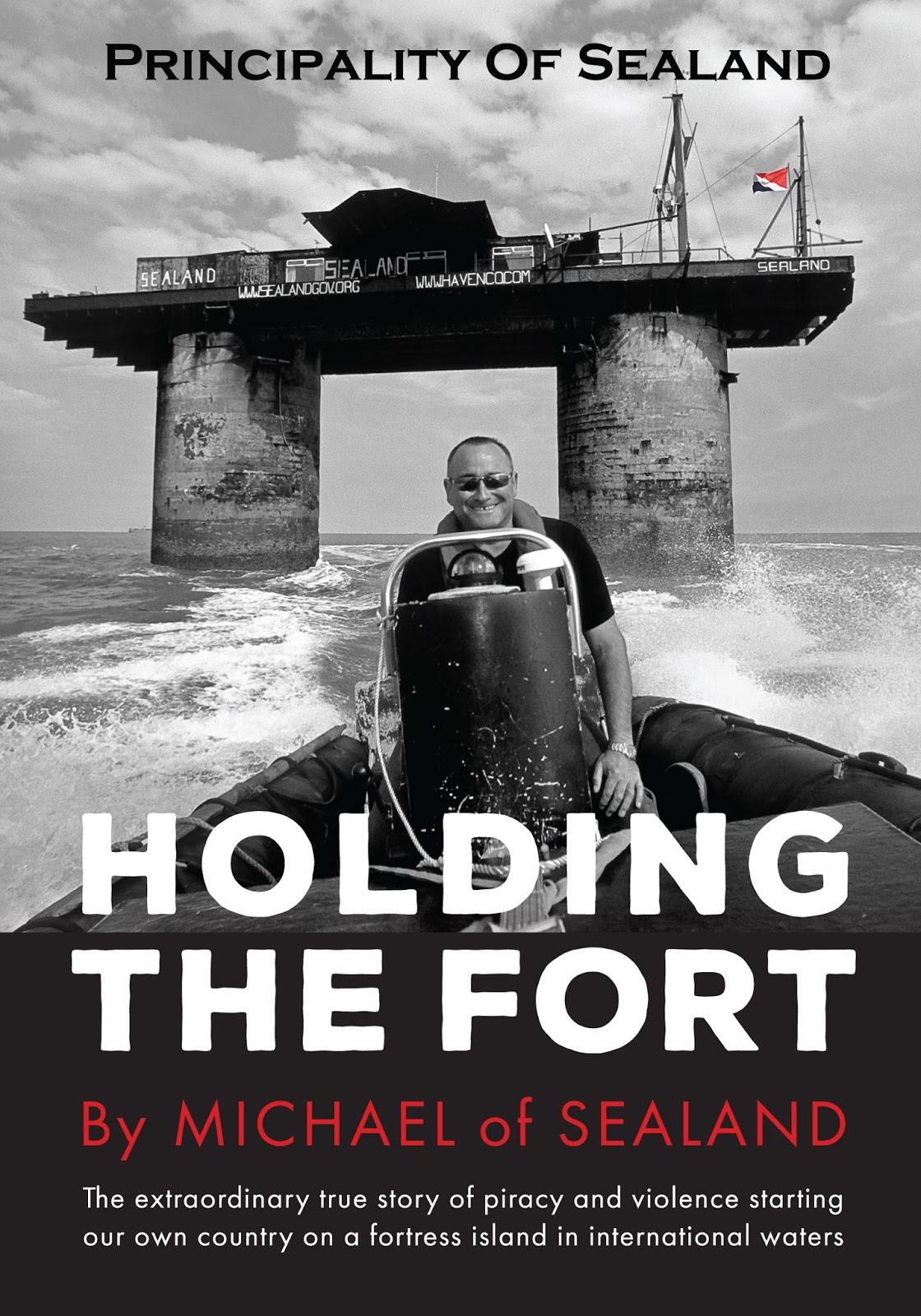
HOLDING THE FORT


The smallest country in the world. This book brings the true story of the Principality of Sealand, the world's smallest independent country situated in international waters on a 4,500-ton Navy Fort. It was originally built during World War II for the defense of The Thames Estuary. The Fort was occupied by the Bates family in 1967 and was headed by Prince Paddy Roy Bates, a title he had given himself. Now, his son Michael has written the book "Holding the Fort" and his story starts with memories to his early childhood, in which it was not always very easy to have a father like his one.

Amazing is the story about what happened in January 1965 — Michael was only a chap of 12 years young — when his old man took him to one of the forts that wasn't occupied since the end of the war. Very detailed he tells what happened that day entering Knock John Fort and sailing on the Mizzy Gell to the coast again with a very silent Roy Bates. In his mind were already plans to be involved in the offshore radio soon.
However when climbing for the second time onto the fort, people from Radio City were already there and he asked them to leave. Returning for the third time the Knock John was occupied again and it took more than a friendly question to get them off the fort. As a result of "his reputation as unstoppable nutter," as Michael described his father, Radio Essex on 222 metres started 24 hours a day.


Detailed memories. What follows in the book "Holding The Fort" is a detailed story about the history of the station as Michael remembers it. He describes the time he was on the fort himself during Christmas holiday from boarding school and comes with some excellent exclusives I hadn't heard before, including about Joshua, the ghost on Knock John.

  Compared to the far more professional stations like Radio London, Radio Caroline and Radio England, Radio Essex was really run on very low budget. Even for those days the equipment used was very unprofessional and you couldn't say they had a professional studio. Essex, at one stage, had to close down due to the fact Roy Bates was prosecuted for broadcasting without a license as it was proved by the authorities that the Knock John towers where within the three miles limit.
  Of course the renaming of the station into Britain's Better Music Station (BBMS) is mentioned. Even now, fifty years on, it's a pleasure for me to listen to the special programs from those two stations, however there are not too much around. As stated, Michael Bates' memories are very good and it's great to read his own findings from that period, including a marvelous story about writing to the GPO about a suspected tapping of the phone at the Bates family house. It was Christmas day 1966 that, due to financial pressure and the continued treat of further fines, Roy Bates decided to end this radio project. Just a few days later the fort was dismantled and the equipment brought to Roughs Tower.
  Extremely interesting is the chapter in which Michael tells about defending, with only one other person, the Roughs Tower during the Christmas period 1966. He was only 15 years of age at that time, but was spectacularly dexterous. After the government brought in the MOA, most stations off the British coast closed down August 14th 1967 — only the Caroline's were still on the air — and again Paddy Roy Bates made the headlines and many people thought that it would only be a short period before we would never hear from him again. But reality was totally different, for Roy Bates and his family would make the headlines over and over again during the next decades.

Taken hostage. Through these past decades several options have been there to make from the Principality a very good success. But, more than once, the independent mini-state came into the press in a not too positive way too, mostly due to action of others involved. I point for instant at the coup made by Mr. Achenbach who started to proclaim in Dutch newspapers that he would soon be the leader of the nation stating: "Sealand über alles". Due to a coup one Dutch man, Hans van Loo, who was first with him on the coup tender and later came back to Sealand, after a recoup by the Bates family and friends, when he was taken hostage.

  Due to publications in Dutch newspapers we already knew that there were plans for starting a radio station on the Roughs Towers and it was Van Loo, the brother in law of Willem van Kooten, who was first sent out to see what the possibilities and facilities could be for starting a radio station there. The second time he came out to the fort from the harbour of IJmuiden was when he wanted to try to get free his friend Evert Bos, who was imprisoned on Roughs Tower.
  In those days I followed the happenings on "Sealand" very intensively and when being informed on daily basis by radio friends in the UK I decided, when I heard that Van Loo was taken hostage, to inform Bert Voorthuysen, a journalist at the Dutch Telegraaf in Amsterdam, about the situation. After several days of negotiation Van Loo got his freedom back and was taken back to the UK and flown back with a KLM helicopter to the Netherlands.
  Michael Bates describes in his book that he thought Van Loo was one of the intruders working for Achenbach, while instead of that he was sent out by Willem van Kooten to bring in the ideas to start a radiostation. Anyway more ideas starting a radiostation came in the last the nineties of last century, when Spangles Muldoon was involved.
  Next to the chapters about the radio projects there are many other chapters of high interest to see what makes "Holding the Fort" complete. Michael Bates "of Sealand" tows you, as a reader, into the long life project of his family and keeps your attention sharp till the last pages. The book has also several color as well black and white photographs, from which a lot I hadn't seen before. I think for everyone interested in radio as well as freedom a must to order, which is possible at Sealand's own website.


Thursday, 26 October 2017

The writers of Micronations

Through Internet, you will find a lot of webpages or blogs talking about micronations. But information is not only Internet. Along our history, the writers and the journalist are the ones who wrote most of the important events and they are the ones who leave the mark. A lot of writers are big followers of micronations. Not only libertarian writeres. A lot of people along the last decades have become enthusiasts of some political alternatives that have emerged. And one of them are the micronations. This entities are peculiar forms of government that allow writers to write about a topic which it is not very known around the world. When somebody says that a platform as Roughs Tower is a State, or when someone says that in Madeira we can find an islet which is a Principality, people get surprised. And this is why I want to make a list of a lot of writers and journalist who have talked about micronations and who have writen several books about this topic. This writers are focused on a curious public which is interested in peculiar political subjects.

BOOKS

Nick Middleton
An Atlas of Countries That Don't Exist: A Compendium of Fifty Unrecognized and Largely Unnoticed States


John Ryan, ‎George Dunford, ‎Simon Sellars, they wrote the book: Micronations, in 2006


Mohammad Bahareth, he wrote ''Micronations: For Those Who Are Tired of Existing Incompetent Governments ...''


Kathy Ceceri, she wrote ''MICRONATIONS: Invent Your Own Country and Culture with 25 Projects''


Micronations: Micronation, Principality of Sealand, List of Micronations, Neue Slowenische Kunst, Republic of Rose Island, Freetown, wroten by Source Wikipedia, LLC Books.


Micronations in the United States: Native American Tribes, Puebloan Peoples, Tohono O'Odham, Cree, Arapaho People, Sauk People, Zapotec Peoples, Lucay, wroten by General Books, 2013 


Horus Michael, writer of Your Micronation Passport: Akua-Niihau and Iapana


La reconnaissance des micro-nations wrote by STEPHANE-BERTIN HOFFMANN


John Hartley wrote Digital Futures for Cultural and Media Studies. It is not a book about micronations but he talks about Subnational minorities where he includes micronations.

Rich Horton wrote Fantasy: The Best of the Year 2006, where ha talks about micronations.
Lonely Planet blue list: the best in travel 2007 by Lonely Planet Publications (Firm).


Books like After the Rain of Sam Vaknin, ‎Lidija Rangelovska or Neptune's Brood of Charles Stross, they also talk about micronations.

K. Somerville in his book Radio Propaganda and the Broadcasting of Hatred, he talks about tribes and he compares tribes to micronations.
Godfrey Mwakikagile is an author who wrote Remembering the Sixties: A Look at Africa and he also compares tribes to micronations.


Peter Sheldrake wrote Elephants on Roller Skates

Valerie Wyatt - 2017 wrote How to Build Your Own Country


ENGLISH BOOKS


“Holding The Fort”, written by Prince Michael of Sealand, the true story of his unbelievable adventures over the last 50 years on Sealand.


The book uncovers the truth behind Michael’s kidnap by armed terrorists, his family setting up their own island nation, government sieges, top secret government documents and multiple attempts to bring an end to the Sealand dream. The book includes previously unseen photos from his family’s personal collection.


“The story of Sealand is stranger than fiction, better than Hollywood and more surreal than Dali” – Ben Fogle (Adventurer, author and broadcaster)


“When a story features sawn-off shotguns, dawn helicopter raids, pistol whippings, temperamental generators, shady tax accountants, devious gangsters and at least one flying headbutt to the bridge of the nose, ‘romantic’ probably isn’t the word that springs instantly to mind. Especially when at the heart of that story is an outwardly charmless, forbidding structure way out in the cold and dark of the North Sea.

Yet the story of the Principality of Sealand is a patently romantic one. It’s a classic case of the underdog kicking against authority and winning; a heartwarming narrative of battling the odds that’s grounded in good old- fashioned British eccentricity. It’s a riproaring yarn, a classic Boy’s Own tale related here by the boy himself, Michael of Sealand, with verve, wit and panache. But look beneath the surface, beyond the guns and dastardly plots, and you learn from these pages that Sealand is also a story of family; of loyalty, respect and devotion flowing between generations and filtered through this tiny principality off the Essex coast; channeled through the dreams, hopes and stubborn stand against seemingly impossible odds of the Bates family.

The story of Sealand is like an Ealing comedy crossed with a Bond film and scripted by John Le Carré. It’s a story that has often been swathed in myth and blighted by rumour, but here, at last, is the definitive tale from the man best qualified to tell it. And he tells it very well indeed.” – Charlie Connelly . Charlie is a bestselling writer and award-winning broadcaster.


FRENCH BOOKS


Mulumbati Ngasha wrote Les relations internationales, where he also talk about micronations

Pierre-Alexis Blevin wrote Les micro-États européens: Étude historique, juridique et fiscale. It is a book about microstates, not micronations. But he also talks about microantions and compare them to microstates in a certain way.
Julien Oeuillet, wrote Le business des vanités


SPANISH BOOKS


Gerardo Martín Pascual wrote En el Corazon de Otros Tiempos and he dedicates a chapter called ''El Consulado de Sealand'' where he talks about the Principality of Sealand and about the ambassadors that this Principality had in Spain in the 90's.

Eleonore Kofman, ‎Gillian Youngs - 2008, wrote Globalization, 3rd Edition: Theory and Practice. They talk about the Principality of Sealand.  
Fernández Mallo, Agustín wrote Proyecto Nocilla


GERMAN BOOKS


A user called Quelle Wikipedia wrote Mikronation: Freistadt Christiania, Seborga, Hay-On-Wye, Kugelmugel, Sealand, Republik Freies Wendland, Ladonien, Principality of Hutt River, Rüterber

Atlas Obscura: Entdeckungsreisen zu den verborgenen Wundern der 
Welt wrote by Joshua Foer,Ella Morton and Dylan Thuras
Anna Margaretha Horatschek,Anja Pistor-Hatam wrote Identitäten im Prozess: Region, Nation, Staat, Individuum
Deutsche Bauzeitung: Fachzeitschrift für Architektur und Bautechnik, Volumen 135

MIKRONATIONER


PRINCIPALITY OF PONTINHA, THE PORTUGUESE CATALONIA


If someone tells you that there is a little Principality to the coast, the first thing it will appear on your mind is Monaco or perhaps Seborga. But, today we are going to talk about another principality, the Principality of Pontinha.


Where is that?

A portuguese citizen bought an islet which is a fort, located in the Port of Funchal, in the coast of the Madeira island. This citizen was ana artist, his name is Renato Barros, but when he bought this famous fort in the coast of Madeira, he self-ploclaimed Prince Renato II of Pontinha delcaring the independence of his fort, the Fort of Sao José. He is an excentric, but he has all the necessary requirements exigible for creating a state. The fort was a private property of the King of Portugal, but he sold it. Prince Renato says if a King solds a part of its territory, he is selling also the sovereignty. And this is why Pontinha is an independent state. But Renato II is a special Prince, he created a country from cero. He created state structures. He redacted a consitution and some petitions for claiming independence from Portugal. Renato lives in his fort, so his principality reaches the principles that the Montevideo Convention requires to an independent state: a government, a population, a territory and the capacity of stablishing diplomatic relations with other states.
Prince Renato II
Renato II appointed a Prime Minister for his country, Joby Weeks. Joby is a very famous person in Internet because of his knowledge about cryptocurrencies, in specific, about bitcoin. When Renato II appointed this Prime Minister for his country, the portuguese and international media become to explain the peculiarities of this little principality. From that moment, the Principality of Pontinha began to have thousands of followers through social media and social networks.
Renato II also offered political assylum for a portuguese politician, who was a candidate for portuguese election. In that moment, Pontinha became very famous in Portugal. Some said that a supposed independence of this islet will damage the image of Madeira's claims for independence.
Is he the most famous libertarian portuguese?
I think so. Portugal had not a big libertarian tradition and Renato II is a very famous person in Portugal because of his claims of Pontinha's independence. He is a libertarian because he appointed to Joby Weeks as a Prime Minister, a libertarian american, also very popular in Internet. Renato II is more than a Prince, he deffeated the Portuguese state claiming independence from his own islet. He is the only one in Portugal which defeated to the state in seceding a part of Portuguese territory with this popularity and success.

TWO PRINCIPALITIES, TWO DREAMS


These last month, everybody is talking about Catalonia. For those who don't know about it, Catalonia is a Spanish Region, it is a Principality located in the North-East of Spain. Some catalans are asking for independence of Catalonia. I won't enter in this discussion. The fact is that the media is always talking about Catalonia but it is not talking about Sealand, about Pontinha, about Seborga...

Media is not talking about micronations like the Principality of Pontinha.
So, Portugal has also its own ''Catalonia''. In Portugal there is a Principality which also wants to secede, it is called the Principality of Pontinha. We can say that Renato II of Pontinha is the portuguese ''Carles Puigdemont, President of Catalonia''. 
Prince Renato II of Pontinha (left) and the President of Catalonia (right)
But, why Media is not talking about the Principality of Pontinha?

We should understand that Catalonia has seven and a half million inhabitants and it represents an important part of spanish GDP. Catalonia is located in a strategic position, it is near the Mediterranean, it borders on France and Andorra. It is one of the most visited regions in Europe for turists. This is not the case of Pontinha, which is a very little Principality on the coast of Madeira. Pontinha receives also a lot of visits but not milions of visits. It has thousands of followers in Internet, but not milions. But the people of Pontinha are asking the same as the catalans. So, I arrive to the conclution that media will always support those projects which can affedct their own interest. Pontinha'n citizens are asking for independence. The polls says, that almost 100% of Pontinha's inhabitants have the desire of being an independent state. It is unfair that international media hide those projects which are not ''politically correct'' or those projects that simply are not accepted by the ''principles of XXI Century''. Medias are not talking about Pontinha because they consider irrelevant, but on the other side, they consider the Catalan issue as very important and interesting.
Catalans and Pontinhans are asking for the same. The Sealanders, the Seborgans and some more micronations are claiming the same, but the media doesn't treat them by the same way.
Document made by
Renato II
Besides, the catalan government should represent all the catalans (those who want independence and those who not). In Catalonia a lot of families are not agree with independende. On the other hand, Prince Renato II of Pontinha is representing all the Pontinhans and in Pontinh's Principality, 100% of the population is claiming for independence. Pontinha is a private islet, so if its head of State, the Prince Renato II makes something that damage its country, he will suffer the consequences, not the people, while if the Catalan government makes a bad desision, seven and a half citizens will suffer the consequences. Renato II is the owner, he can makes whatever he wants he is the one who will decide the future of his fort, the one of the San José.
The King of Portugal sold the territory to the Blandy family, and then this family sold the islet to Renato Barros, the now Prince Renato II.
Renato II alleges that if a sovereign sells a territory, he sells the property and the sovereignty of that territory. And this is the real reason why Pontinha has the right of becoming an independent state. Catalonia has not this right, the region has multiple owners and the president is just a bureaucrat.
Renato II can apply the principles of self-determination and the libertarian principles of self- ownership. He can decide to be the sovereign of his own property. 

RELATIONS WITH PORTUGAL

If Catalonia has bad relations with the Spanish state, Pontinha also has bad relations with the Portuguese state. The only difference is that the Islet that Renato II owns is his private country while Catalonia is not a private property owned by just one person.
The mass media don't see this or perhaps ''they don't see this''. The truth is that we live in the XXI Century and libertarians points of view are conquering the Internet and are spreading each time faster.
There are some powerful organizations that want to defeat governments, the Seasteading Institute, which is an organization that wants to build floating cities in International Waters with the aim of creating autonomous goverments. The objective of this kind of organizations is to scape from strong government regulations and of course, avoid taxes. In the XXI Century, it has no sense to pay te amount of taxes that we pay. Our governments should not need all this money, we have the enough technology to develop enterprises and industries that allow everyone to have a work ant to save money each month.
Seasteading Institute is supported by very well-known economists and businessmen, like Patri Friedman or Peter Thiel. In Spain, Instituto Elcano is a libertarian institute that support little governments. Jesús Huerta de Soto is a brilliant spanish economics professor, he is a libertarian very well-known in Spain for his explanations of economy and for his desires in supporting little countries. So Libertarianism lives a good moment and is still growing and growing, because people are fed up of governments. Renato II of Pontinha appointed a libertarian american as its Prime Minister. He is Joby Weeks, an entrepreneur who works in bitcoin businesses. Renato II also says that Google recognizes his territory as an independent state. This is good news for him, to know that technology developers, economists and logical people are with him.
Renato II of Pontinha is a peace man, who wants to dialogue with the government of Portugal, he tries to stablish diplomatic relations with the Portuguese Republic. He is making a lot of effort. But Portugal says no to its claiming situation. Renato II is annoyed with this situation.

Petitions made by Renato II and translated to catalan (left) and spanish (right) languages
Renato says he is suffering a lot of tensions by the Portuguese State. He tries to get independence of his nation and he wants to reach a treaty with Portugal that allows him to make a referendum of self-determination. Portuguese authorities are refusing his proposals. Renato II ensures that the EU will accept his right of self-determination and he ensures they want to help Pontinha, but on the other hand Portugal is closing any help to Pontinha.
In this article I won't enter in politic and juridic issues, but I will just give my opinion about those medias who hide the desires of Pontinha of becoming an independent state.
Pontinha has at least, the same right of appearing in the international medias, as Catalonia does. The same for Sealand, the same for Tavolara and Seborga, and many other countries which have the same desire.


VERBUM VOLAT, SCRIPTUM MANET

Welcome to Self Herald

This is a blog where you can learn about micronations and about all kinds of extrange political situations. This blog is also a media blog. I will publish all kind of news related with this semi-sovereign nations or projects that one day can reach the flag of freedom.
Self Herald is not a blog about microstates, it is a blog about micronations.


Which is the difference between a microstate and a micronation?


A microstate it is a small recognised country like Andorra, Monaco, San Marino and so on, while a micronation it is a country which it is not recognised or which is partially recognized, no matters the size it has.

Self Herald will give you the information you need for understand what a micronation is, what kinds of micronations exists on the planet and how do they work. You will be informed of a lot of geopolitical situations that exists in our world and which you never have realized.

Only 193 countries are recognized by the ONU, but among 400 countries in the world are asking for international recognition.
This blog will not only report the micronations that exists today in the planet, but also the micronations and all the peculiar geopolitical situations that have happened in the world along the centuries.
This is a libertarian blog which defends international recognition for all territories and nations who claim to be recognized as they are. Libertarians share an economic and political view in common. Most libertarians defend micronations, because one of the points that libertarians defend is the right of self-government, so we can say this blog is also about libertarianism and self-government.

Would you like to have a Passport from Pontinha?

Prince Renato II of Pontinha is fighting for the Independence of his own country, the Principality of Pontinha. The government of Portug...